

Company Valuation Singapore: A Complete Guide for SMEs
Introduction: The Valuation Gap in Singapore’s SME Landscape
When you own a small business, particularly in a place like Singapore, there’s a tendency to not think about how much your business is worth until you really must. This might happen when a co-founder wants to leave, someone wants to buy your company, you want to raise equity, or a bank asks for formal paperwork.
At that point, you might find out that your own idea of your business’s value isn’t quite the same as what someone else’s. It’s like having a vague idea of your business’s value, but not really knowing for sure until someone else comes along to give a reality check.
This gap has material consequences. Businesses entering negotiations without a credible Company Valuation Singapore assessment often risk leaving money on the table or pricing themselves out of deals that were otherwise viable opportunities, both outcomes being largely avoidable.
This article walks you through the most widely used valuation methods, explains what influences your company’s worth in Singapore’s business environment and helps you understand what you can do to strengthen your position before any valuation exercise.
Key Takeaways
- Valuation need not be a one-time exercise, it can be a strategic lens through which business decisions can be regularly examined.
- No single methodology adequately captures the full economic reality of an SME; a combination of approaches typically yields the most defensible estimate.
Intangible assets like customer relationships, proprietary processes, software, brand are systematically underrepresented in conventional balance sheet assessments.
What Is Company Valuation and Why Does It Matter for SMEs?
At its core, company valuation is the process of determining the economic worth of a business. It is not just a number for the balance sheet; it provides valuable insights to investors, buyers, shareholders, and financial institutions regarding the current value of the business and its potential to generate future returns.
The QBE Singapore SME Survey, conducted between December 2024 and January 2025, found that 51% of SME decision-makers were facing challenges in managing cash flow and accessing funding, a notable increase from 36% in the previous year.
When credit tightens and buyer sentiment shifts, valuation multiples compress. This means that the same business can be more valuable or less, depending on when it’s being valued. The terms of a deal can change dramatically, just because of the timing.
For SMEs in Singapore, a credible Company Valuation Singapore report can:
- Help you negotiate from a position of strength during fundraising.
- Support loan applications and credit facilities from financial institutions.
- Provide a fair basis for shareholder buyouts or equity splits.
- Assist in succession planning and business transfers.
- Attract strategic partners or acquirers at the right price.
Common Company Valuation Methods
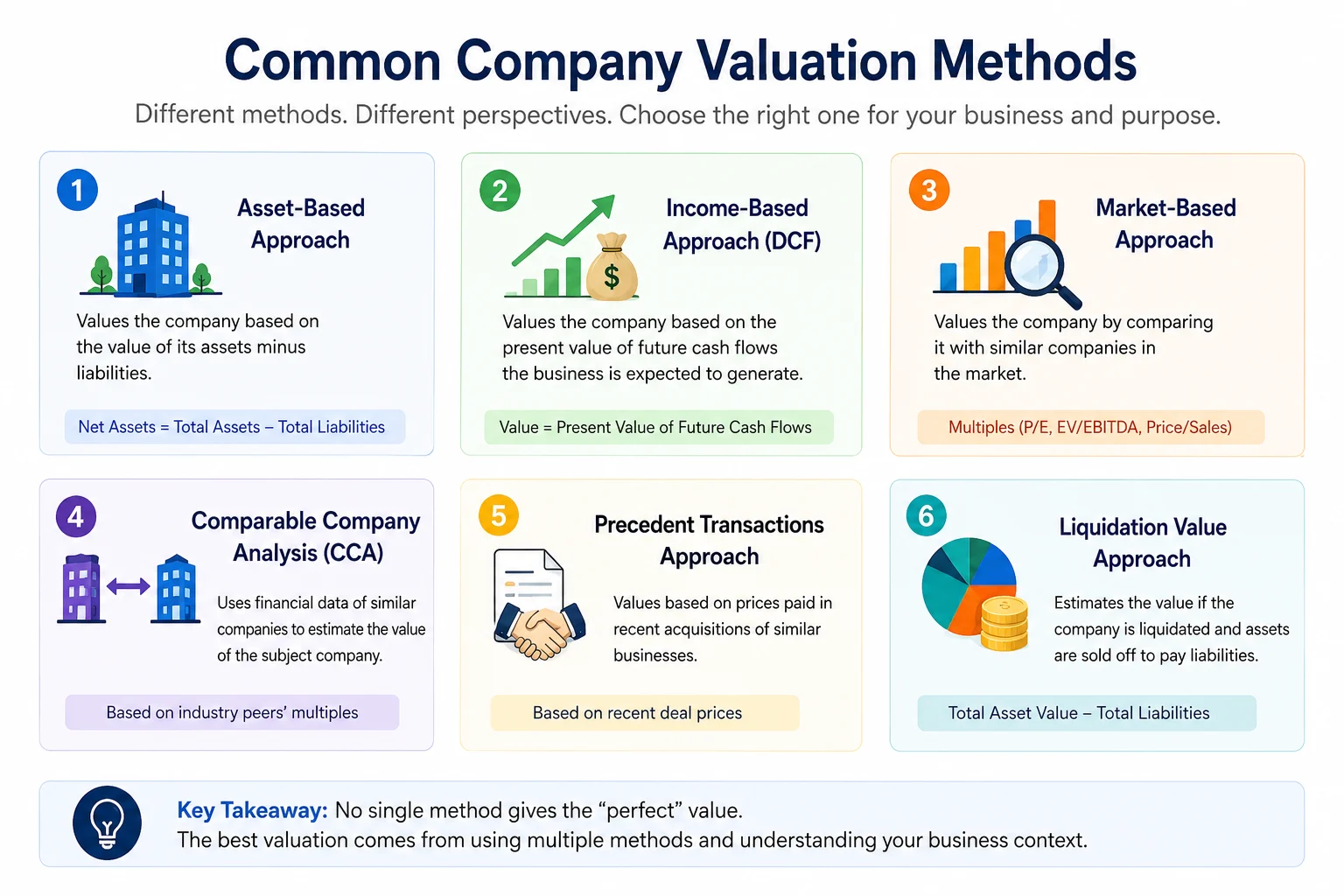
There is no single approach that fits every business. Valuation professionals for Company Valuation Singapore typically use one or more of the following approaches, depending on the nature and stage of the business.
1. The Income Approach: Discounted Cash Flow (DCF) Method
This is perhaps the most analytically rigorous approach. DCF valuation projects your future cash flows and discounts them back to present value using an appropriate rate that reflects risk.
DCF is suited for most types of businesses including start-ups with clear visibility of revenue and cash flows or established businesses with predictable, recurring revenues such as subscription-based services or established B2B companies.
However, the downside is DCF’s sensitivity to input assumptions means small changes produce dramatically different outputs like a discount rate of 15% vs 18% on a five-year projection can shift a valuation by 20% or more. For SMEs with limited financial history or irregular revenue, the inputs used in a DCF must be realistic and well-supported.
2. The Market Approach: Comparable Company Analysis
This approach is often referred to as market-based valuation, where your business is compared to similar companies that have recently been sold or listed on a stock exchange.
In an established market like Singapore, you can usually find data on recent transactions to use as a benchmark for Company Valuation Singapore. If such data is unavailable, one can consider regional or ASEAN countries data on recent transactions.
Key metrics used in this approach are Revenue multiples, EBITDA multiples, and Price-to-Earnings (P/E) ratios. This method is especially popular during M&A transactions because it reflects what buyers are actually paying in the current market. In addition, this approach is more simplistic and, in a way, short-cut method to the DCF method.
3. Asset-Based Valuation
This method calculates the net value of your company’s assets, both tangible (property, machinery, inventory) and intangible (patents, trademarks, software to the extent recorded on the balance sheet). This approach is most relevant for asset-heavy businesses, companies in financial distress, or situations where the going-concern assumption is being questioned.
What this approach fails to capture is the economic contribution of intangible assets. Customer retention rates, proprietary processes, brand recognition within a particular trade or sector, relationships with key customers or suppliers do not appear on the balance sheet, yet all factor into what a buyer would pay.
Factors That Influence Company Valuation
Getting a Company Valuation Singapore assessment done is only part of the exercise. Understanding what drives or depresses that number is equally important, especially if you’re preparing for a corporate finance event (sale, fund raising, etc.) in the next 12-24 months.
Financial Performance
This is the most obvious driver. Consistent revenue growth, healthy margins, and strong cash flow generation all push your valuation higher. Audited financial statements especially for the last three years can carry significant weight with both investors and valuers.
Industry and Market Position
The businesses that operate in high-growth sectors such as fintech, healthcare, or sustainable technology, tend to attract premium multiples in Singapore. Your market share, brand strength, and competitive differentiation also matter significantly.
Management Team
Buyers and investors pay a premium for companies that are not overly dependent on the founder. A capable management team, documented processes, and clear succession plans reduce risk and that reduction in risk is directly reflected in the valuation.
Regulatory Environment
Singapore’s business-friendly regulatory environment, transparent legal system, and strategic position as a regional hub add a layer of credibility and stability to valuations. The country’s strong rule of law, low corruption index, and mature capital markets are factors that external investors and acquirers value highly. This often results in Company Valuation for Singapore companies attracting higher multiples compared to peers in some neighbouring markets.
Preparing for a Company Valuation Singapore
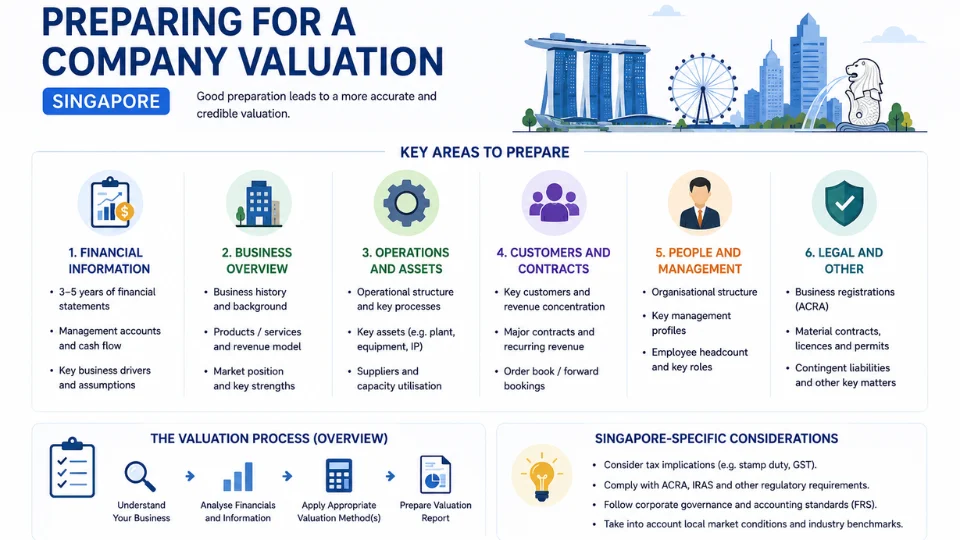
If you’re planning to get a Company Valuation in Singapore in the near future, here are some practical steps to prepare:
- 3 years of consistent management accounts ideally reviewed or audited as it significantly reduces the due diligence burden and signals operational credibility.
- Owner remuneration above market rate, personal expenses processed through the business, and non-recurring items should be identified and adjusted for before presenting financials to any external party.
- Intangible asset documentation; client contracts, renewal history, staff retention data, and any registered intellectual property should be compiled and made readily accessible.
- Any known risks such as customer concentration, key-person dependency, unresolved legal matters should be better addressed proactively and disclosed to the valuer.
- Engaging an experienced, credentialed valuer, ideally with direct experience in Singapore SME transactions well in advance of any anticipated transaction materially improves both the quality of the valuation and the owner’s ability to use it effectively in negotiations.
Conclusion
Company Valuation Singapore is not just a technical exercise; it’s a strategic tool that helps SME owners make informed decisions at every stage of the business journey.
Whether you’re growing, selling, restructuring or simply planning ahead, knowing what the value of your company is gives you a clear advantage.
If you’re ready to explore your Company Valuation in Singapore, working with a professional valuer who understands both the local market and global valuation standards is the smartest first step you can take.
It found 51% of SME decision-makers faced challenges managing cash flow and accessing funding, up from 36% the previous year, which the article links to valuation multiples compressing when credit tightens.
The article notes that shifting the discount rate from 15% to 18% on a five-year projection can change the resulting valuation by 20% or more, illustrating why DCF inputs must be realistic and well-supported.
It fails to capture the economic contribution of intangibles such as customer retention rates, proprietary processes and brand recognition, which don't appear on the balance sheet yet affect what a buyer would actually pay.
It recommends compiling three years of consistent management accounts, ideally reviewed or audited, to reduce the due diligence burden and signal operational credibility to valuers and counterparties.
Owner remuneration above market rate, personal expenses run through the business, and non-recurring items should be identified and adjusted for before presenting financials to any external party.
Singapore's strong rule of law, low corruption index, transparent legal system and mature capital markets add credibility and stability, which the article says often results in Singapore companies attracting higher multiples than peers in some neighbouring markets.
